
Truth
Living and speaking with honesty at all times, in all circumstances.
Freedom through Education
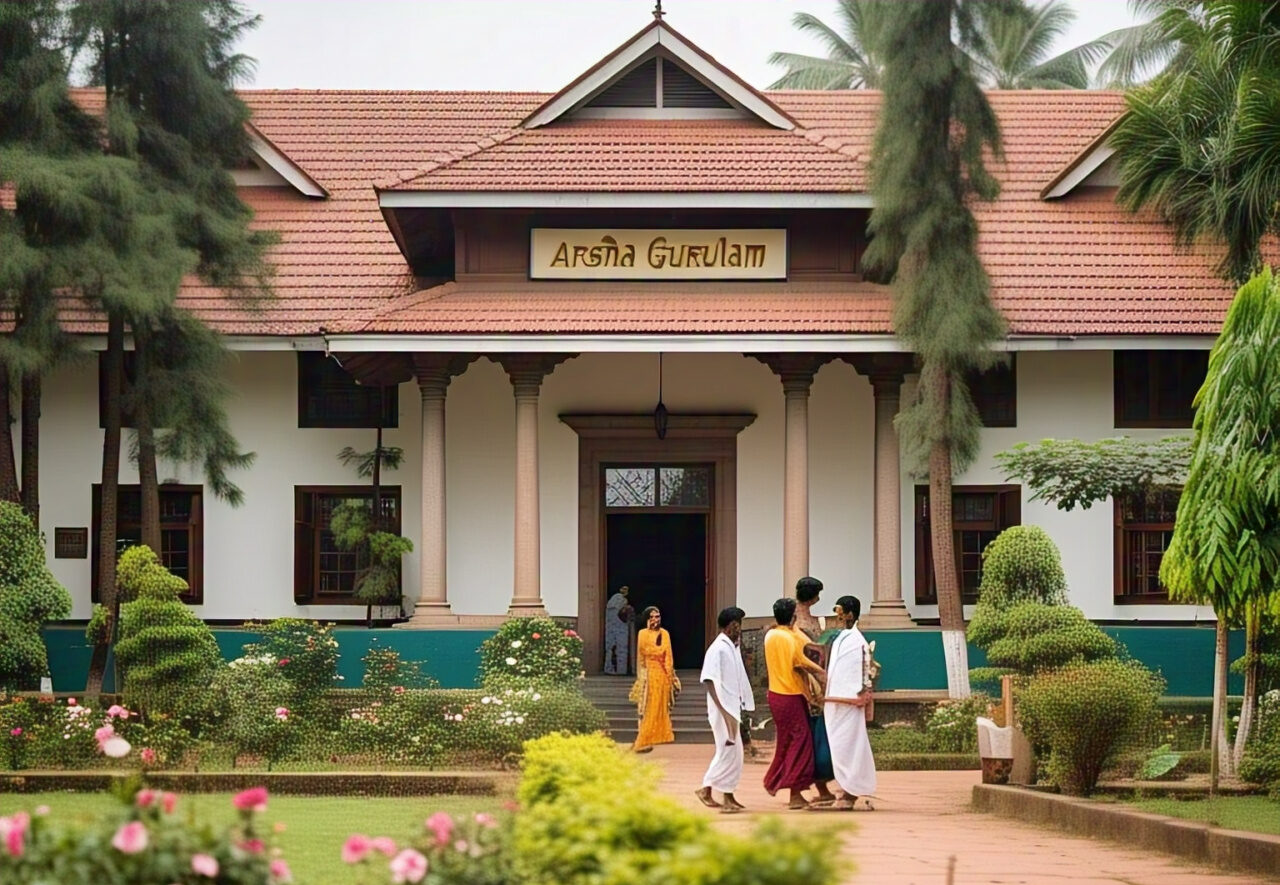
An institution combining the best of the traditional Gurukulam way of learning with modern technical training. Nurturing a generation rooted in truth, with emphasis on selflessness, compassion, patience, and sacrifice over competition.
What is a Gurukulam?
This is where Arsha Gurukulam stands apart — nurturing a generation rooted in truth and righteousness, with an emphasis on selflessness, compassion, patience, and sacrifice over competition.
Our vision is to revive the ancient Gurukulam system through a tech-integrated model that combines spiritual and material learning. The platform promotes multilingual learning, allowing students to explore India’s linguistic richness while experiencing their inner self.
Core values
Education is not about competing or winning. It is about acquiring knowledge and living by it.
Living and speaking with honesty at all times, in all circumstances.
Understanding the suffering of others and acting to reduce it.
Endurance, persistence, and equanimity in the face of difficulty.
Willingness to give up personal comfort for a larger purpose.
Acting without personal interest — for the benefit of family, society, and the universe.
What students learn
A complete education rooted in the traditional gurukula subjects — studied as living practice, not memorised syllabus.
Systematic study of Vedic texts — Samhitā, Brāhmaṇa, Āraṇyaka, Upaniṣad — in their original sequence, with traditional commentary. The śruti is understood as it was meant to be: through hearing, reflection, and assimilation.
Grammatical instruction based on Pāṇini's Aṣṭādhyāyī, daily recitation of classical literature, and practical capacity to read commentary texts independently.
Advaita Vedānta as a living inquiry — not a catechism to be memorised. Works of Ādi Śaṅkarācārya, Ramana Maharshi, and the Upaniṣadic corpus are studied with practice as context.
The physical dimension of Yoga understood as preparation for meditation and inquiry — not as fitness. Āsana, prāṇāyāma, and kriyas taught in sequence with their intended function.
Bharatanatyam, Kuchipudi, Carnatic vocal, or traditional fine arts — selected by the student with guidance. The arts are understood as limbs of spiritual practice, not extracurricular.
Hands-on engagement with the ashram farm as part of the curriculum. Ecology is taught as a spiritual subject — the earth as the first Guru of patience, abundance, and non-separation.
How it works
Admissions
Spiritual education, along with material education, is key to shaping a generation
with values that benefit ourselves, family, society, and the Universe.